
Link building can move rankings quickly by increasing authority, while content SEO builds steady, compounding growth that’s harder to replicate. The better strategy isn’t about choosing one over the other, but understanding what each actually drives.
Unfortunately, many businesses treat them as separate efforts. They either invest heavily in content that never gains visibility, or focus on link building without improving the pages those links point to. In both cases, the strategy breaks down before it produces meaningful results.
This article covers how each strategy works and when one outperforms the other. By the end, you’ll know exactly which move makes more sense for your SEO strategy.
Let’s start with the basics.
Link Building vs. Content SEO: What’s the Difference?
Link building builds authority through backlinks from other websites, while content SEO improves how well your pages match what people are searching for. Both influence rankings, but they rely on different signals.
Link building is part of off-page SEO. It works by getting other sites to link to yours, which signals to search engines that your content is worth ranking. The more high-quality links pointing to your site, the more authority it builds over time.

Content SEO, by contrast, works on your own pages. It focuses on creating high-quality content that aligns with search intent and delivers real value to readers. When done well, it can attract consistent organic traffic without relying on outreach.
Which Strategy Delivers Better Results?
Honest answer: It depends on your starting point. If your site has strong content but little authority, link building will have a bigger impact. For sites that already have authority but pages that lack depth, content SEO will drive better results. Most businesses fall into one of these two scenarios.
Below, we break down how each strategy performs in practice so you can see which has the greater impact.
Link Building: Faster Gains, Higher Risk
Link building can move rankings quickly because backlinks remain one of the strongest authority signals in SEO. According to Backlinko’s ranking study, the #1 result in Google has 3.8x more backlinks than pages ranking in positions 2 through 10. That gap helps explain why link building can move rankings faster than most on-page changes when your content is already strong.
But the speed comes with risk. Low-quality links from irrelevant or spammy sites can lead to penalties that are painful to recover from. We’ve seen sites drop off the first page of search engine results pages entirely after a single bad link-building push. Even worse, clawing back those rankings takes far longer than building them did.
Bottom Line: Link building delivers the most value when your content is already strong but lacks the authority to compete. Without that foundation, even high-quality backlinks will struggle to produce lasting results.
Content SEO: Slower Growth, Stronger Compounding
Think of content SEO like a savings account. The returns look small at first, but every page you publish keeps earning without additional spend. Well-optimized, high-quality content can rank for dozens of related search queries, often pulling in traffic from searches you never explicitly planned for.
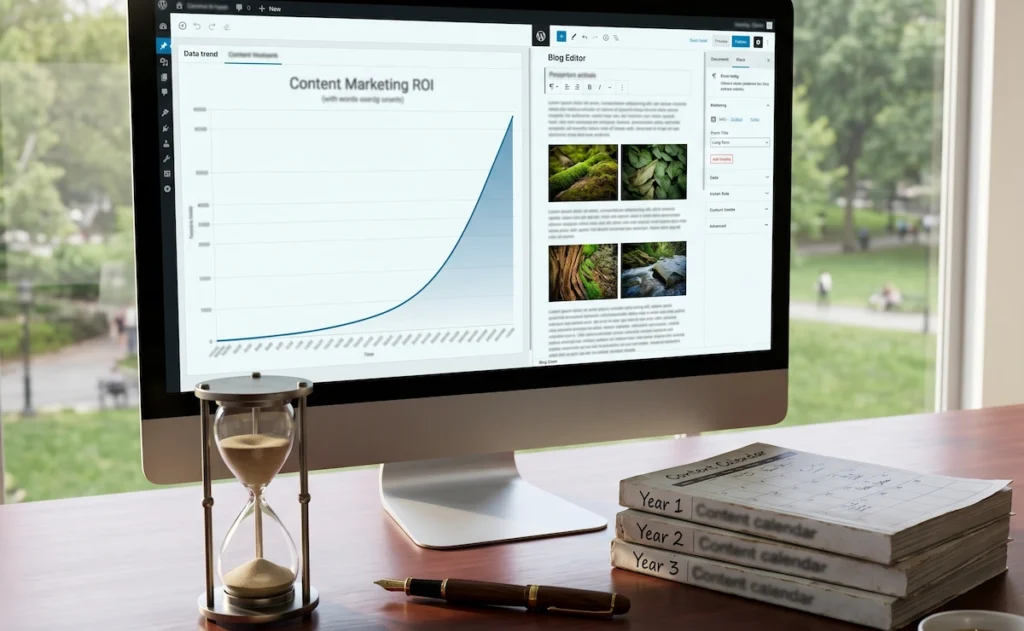
And unlike link building, where visibility depends on external signals, content SEO builds durable value directly within your pages. It continues attracting organic traffic over time, as long as it stays relevant and aligned with search intent.
Content Quality vs. Domain Authority: How They Work Together
Neither one works in isolation. A high-authority domain with weak pages stalls, and great content on a brand-new site gets ignored. Here’s how the two actually interact:
- Authority Has Limits: If your domain authority is strong but your content is thin or off-topic, those pages will still struggle to hold rankings. That’s because Google tends to reward sites that combine authority with pages that genuinely answer what people are searching for.
- Content Quality Is What Makes Rankings Stick: Strong content helps search engines understand what your page is about and who it serves. When that content is well-structured and genuinely useful, it also signals depth (something many authoritative sites with shallow pages often lack).
- The Two Build on Each Other: Sites linking to your content raise your domain authority, which helps your other pages compete. But those links only come when your content is genuinely link-worthy. One feeds the other, and neither works as well without it.
In our work with SEO clients, the sites that grow most consistently treat content quality and domain authority as a cycle rather than a checklist.
We’ve seen this play out with a local café. Once its domain authority improved, new content began earning links more easily, and each piece ranked faster than the last. That’s the compounding effect in action, and it’s hard to replicate when you’re only focused on one side of the equation.
Cost, Scale, and ROI Comparison
Before choosing one over the other, it helps to compare what each costs in time, money, and expected return. The table below breaks it down:
|
Factor |
Link Building |
Content SEO |
|
Upfront Cost |
Link Building |
Low to medium |
|
Time to Results |
Faster (weeks to months) |
Slower (months to a year) |
|
Scalability |
Limited |
High |
|
Durability |
Risk of penalties |
Long-lasting |
|
Measurability |
Harder to track |
Easier via tools like Google Analytics |
|
Referral Traffic |
Yes, via backlinks |
Limited |
Link building typically requires higher upfront investment, whether through agency fees or in-house outreach. While results can come faster, they’re harder to sustain without ongoing effort and spending.
Content SEO, by contrast, scales more efficiently. Performance is easier to track through tools like Google Search Console and Google Analytics. That makes it simpler to measure ROI and refine your approach over time.
What to Prioritize First
For most sites, content comes first. Without pages worth linking to, even the best link-building campaign has nothing solid to stand on.
So start by making sure your technical SEO is in order. That means checking site architecture, fixing broken links, and optimizing title tags and meta descriptions. A quick SEO audit can surface many of these issues faster than expected.

With that in place, focus on building content that genuinely serves search intent. You can also support it with internal links, structured data, and core web vitals. Together, these give your strategy a stronger base before investing in link building.
Once your content starts gaining traction in search rankings, that’s the point to layer in link building. At this point, SEO works best as a process, with each step reinforcing the next. This sequencing is what separates sustainable growth from wasted spend.
Frequently Asked Questions
We often get asked about link building and content SEO. These are some of the most common ones:
Is link building still relevant in 2026?
Yes, but quality matters more than quantity. A handful of editorial backlinks from authoritative sites will always outperform dozens of links from low-quality sources.
How long does content SEO take to show results?
Most pages take 3 to 6 months to gain meaningful traction, depending on competition and domain authority. Newer sites may take longer, but the returns compound over time.
Can I do both link building and content SEO at the same time?
You can, but it works better in sequence. Build content first, then earn links to your strongest pages. Running both without a foundation usually spreads resources too thin.
Build Your SEO Foundation the Right Way
By now, you have a clearer picture of what each strategy does and when to use it. The sites that win long-term stop treating link building and content SEO as competitors and instead use them as a process. To get started, follow this sequence:
- Audit Your Site First: Before anything else, identify what’s already working and where the gaps are.
- Build Content Around Search Intent: Quality content that answers real questions is the foundation of any solid SEO strategy.
- Earn Links to Your Best Pages: Once your content is strong, focus your link-building efforts on pages with the clearest path to ranking.
- Track and Refine: Use Google Search Console to monitor performance and adjust as your online visibility grows.
If you’re not sure where your site stands right now, we’d be happy to help. We’re Fiddlers Convention, and we’ve spent over a decade helping businesses grow through content strategy, link building, and search engine optimization. Reach out to our team and we’ll help you figure out the right next step.